The difference between a vehicle tracking system and a shuttle tracking system
A GPS vehicle tracking system tells you where a vehicle is; shuttle management tells you whom it carries, from which stop and when. We explain the difference between the two approaches, when each is enough and how they work together.
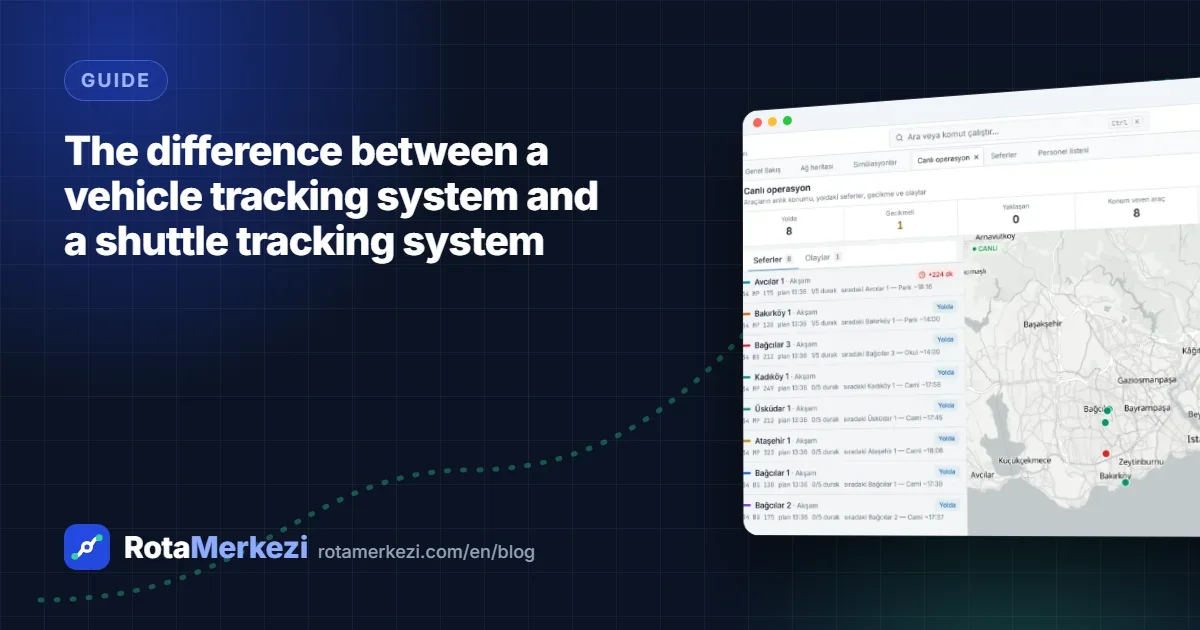
A vehicle tracking system shows where a vehicle is, how fast it is going and where it has stopped; a shuttle tracking (shuttle management) system combines that same location with passenger, stop, line and trip information to answer the question "who is being carried, from which stop, and when?" Which one you need for employee shuttles depends on whether your need is fleet management or a passenger transport operation. The two systems are often not competitors but complementary parts.
What does a GPS vehicle tracking system do?
A classic GPS vehicle tracking system receives location data from a device installed in the vehicle and shows it on a map. Its typical features are:
- Real-time location and past route (route history)
- Speed, stop duration, ignition on / off
- Geofence entry and exit alerts
- Fuel and mileage reports
- Driving behavior indicators
These systems are valuable for the fleet manager: they answer questions such as where the vehicle is, how it is being used and whether maintenance is due. But a vehicle tracking system does not know what the vehicle is carrying.
What does a shuttle tracking system add?
For employee shuttles, the real question is not "where is the vehicle?" but "when will my shuttle reach my stop, how many people boarded today, and what will we pay the vendor this month?" A shuttle management system adds the following layers on top of location data:
- Passenger assignment: which employee belongs to which stop and line
- Stops and stop sequence: the line's route and the planned time at each stop
- Trip calendar: daily trips based on the shift calendar and public holidays
- Boarding records: who boarded, via QR, card or driver check-off
- Estimated arrival at stops: an up-to-date ETA for each stop based on the vehicle's location
- Passenger information: employees see their own shuttle and its live location
- Vendor payments and SLAs: vendor payment based on completed trips and punctuality
Comparison table
| Topic | GPS vehicle tracking system | Shuttle tracking / management system |
|---|---|---|
| Basic unit | Vehicle | Line, trip and passenger |
| Live location | Yes | Yes (from a GPS device or the driver app) |
| Stops and stop times | Usually none or limited | Yes |
| Passenger assignment | No | Yes |
| Boarding records | No | QR, card or manual check-off |
| Estimated arrival at stops | No | Yes |
| Employee app | No | Live location, QR boarding, "I won't be riding" |
| Route planning and optimization | Usually no | Yes |
| Vendor payments and SLAs | No | Based on completed trips |
| Fuel, ignition, driving behavior | Strong | Not the focus |
The table clearly shows that the two systems answer different questions. A vehicle tracking system measures the health of the fleet; shuttle management measures the quality and cost of the transport service.
When is vehicle tracking enough?
A general-purpose vehicle tracking system may meet your needs in the following situations:
- You have a small number of lines with fixed routes that don't change
- You have few employees and the passenger list hardly ever changes
- Your priority is fleet matters such as fuel, maintenance and driving behavior
- The vendor payment is a simple fixed monthly fee and punctuality measurement is not required
When do you need shuttle management?
If several of the following signs apply, vehicle tracking alone is not enough:
- You have hundreds or thousands of employees and many lines and shifts
- Employee joiners, leavers and address changes are frequent
- Employees keep calling the operations team asking "where is the shuttle?"
- Line occupancy and cost per person are unknown
- Vendor payments need to be calculated based on completed trips and SLAs
- Different departments manage their own shuttles in a multi-campus organization
Hospitals, universities, factories and public institutions usually fall into this second group.
How do the two work together?
If your vehicles already have a GPS tracking device, you don't have to throw that investment away to move to shuttle management. A well-designed shuttle management system should be able to receive location from different sources.
In RotaMerkezi, vehicle location can come in three ways:
- From a GPS device via HTTP: the device or the device provider's platform sends the location to a REST endpoint or via webhook.
- Through an MQTT bridge: location is received directly from GPS devices that use the MQTT protocol.
- From the driver app: if the vehicle has no device, the driver app on the driver's phone becomes the location source.
Once received, the location is matched with the trip and line; the live vehicle tracking screen generates alerts for delays, route deviations and GPS loss and calculates the estimated arrival at each stop. Details of the connection options are on the integrations page.
In this setup, the division of labor is clear: the vehicle tracking system can continue to be used on the fleet side for matters such as fuel and driving behavior, while the shuttle management system handles the passenger and service side.
Practical steps for the transition
- Find out from your device provider which method (HTTP, webhook, MQTT) your existing GPS devices can use to send data.
- Plan the driver app as the location source for vehicles without a device.
- Clean up and import employee, stop and line data.
- Start a pilot with a few lines; validate location, ETA and boarding data together.
- Clarify vendor payment and SLA rules with the vendor.
A note on privacy
In both systems, location data can qualify as personal data. In shuttle management, what is tracked is the location of the shuttle vehicle during the trip; employees' real-time location should not be collected. We recommend assessing your obligations under Law No. 6698 on the Protection of Personal Data (KVKK, Turkey's data protection law, comparable to the GDPR) with your organization's legal department; this note is not legal advice.
Conclusion
A GPS vehicle tracking system answers "where is the vehicle?" well; for employee shuttles, the real need is to make that location meaningful with passenger, stop and trip information. To see how your existing GPS infrastructure can be combined with shuttle management, you can request a demo or explore the live vehicle tracking feature.
Frequently asked questions
Can we use our existing GPS vehicle tracking devices for shuttle management?
Usually yes, if your device or provider can send location via HTTP (REST / webhook) or MQTT. You need to confirm this with your device provider.
Can shuttles be tracked if the vehicle has no GPS device?
Yes. The driver app can be used as the location source during the trip, and live location and estimated arrival are calculated from that data.
Can a vehicle tracking system calculate employee shuttle vendor payments?
Usually not, because general-purpose vehicle tracking systems don't know about trips, stops and passengers. Vendor payments based on completed trips and SLAs require a shuttle management system.