Planning and optimization
Route optimization and line redesign
Redesign selected lines within vehicle capacity and a maximum ride time limit, and carry the same employees with fewer vehicles and fewer kilometers.
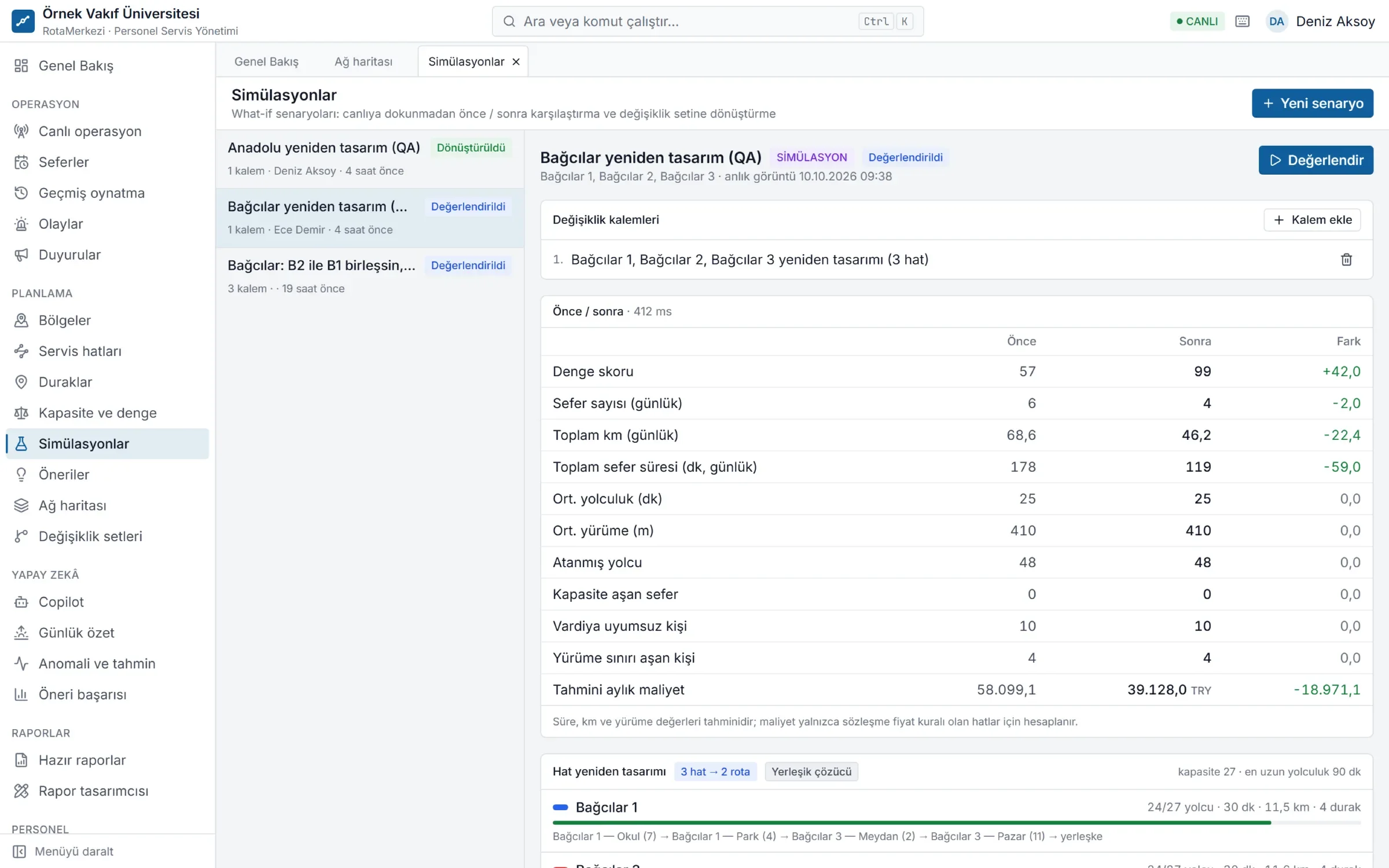
Redesign your lines from scratch
RotaMerkezi solves the passenger-carrying stops on the lines you select as a vehicle routing problem (VRP). You set the constraints, such as vehicle capacity, the maximum time a passenger may spend on the shuttle and the maximum number of routes.
How does it work?
- Within a scenario, select the lines to redesign and enter the constraints.
- The optimization engine calculates the morning routes; evening routes are the same stops in reverse order. Employees keep their stops.
- The proposed routes are matched to existing lines by passenger overlap; any extra route is proposed as a new line.
- The result is shown with the difference in daily kilometers, number of vehicles and monthly cost.
- If it looks right, the scenario is converted into a change set and applied after approval.
Reliable results
The solution is computed in parallel with the industry-standard Google OR-Tools and a built-in heuristic solver, and the better result is chosen. The plan that is approved is exactly the plan that is applied.
What does the optimization take into account?
- Capacity: Only passenger seats are counted; the driver's seat is not included in capacity. You can try a scenario with a different vehicle type ("27+1 instead of 19+1").
- Maximum ride time: No passenger's time on the shuttle exceeds the limit you set.
- Number of routes: You can cap the number of vehicles that may be used.
- Campus and shift: Morning routes end at the campus before the shift starts.
- Cost: Estimated monthly cost is calculated from the pricing rules in the line's vendor contract (per km, per trip, per line or per seat). If no contract is defined, cost is shown as "no data"; no estimate is made up.
Route optimization vs. capacity balancing
Route optimization redraws the lines' routes. Capacity balancing, by contrast, leaves routes untouched and moves passengers between lines to even out occupancy. Both can be used together in the same scenario. Balancing first and redesigning lines only if needed gets you results with the fewest changes.
Change sets and rollback
Optimization results are never written straight to live data. The scenario is converted into a change set: new line versions plus vehicle and passenger assignments. The set is published after approval by an authorized person other than the one who prepared it. Capacity is checked again at publication; if live data has changed since the evaluation, the conversion is rejected. Applied changes can be rolled back when needed with a reverse change set.
Frequently asked questions
Which algorithm does route optimization use?
Line redesign is solved as a capacitated vehicle routing problem in parallel with Google OR-Tools and a built-in heuristic solver; the better of the two results is chosen. The stop order within a single line is improved as a traveling salesman problem using nearest insertion, 2-opt and or-opt.
Is the optimization result applied automatically?
No. The result is first shown as a before/after comparison. To apply it, the scenario is converted into a change set and must be approved by an authorized person other than the one who prepared it.
Do employees' stops change?
In a line redesign, employees stay at their current stop; what changes is which line serves that stop and in what order. If a stop change is needed, stop suggestions or a passenger move scenario are used separately.
How are cost savings calculated?
The difference in daily kilometers and number of vehicles is applied to the pricing rules in the line's vendor contract and shown as an estimated monthly cost. For a line without a contract, cost is marked as "no data".