Live operations
Live vehicle tracking and arrival estimates
Watch every shuttle live on the map. Get alerted the moment a delay, route deviation or GPS loss occurs, and let employees see where their shuttle is on their phone.
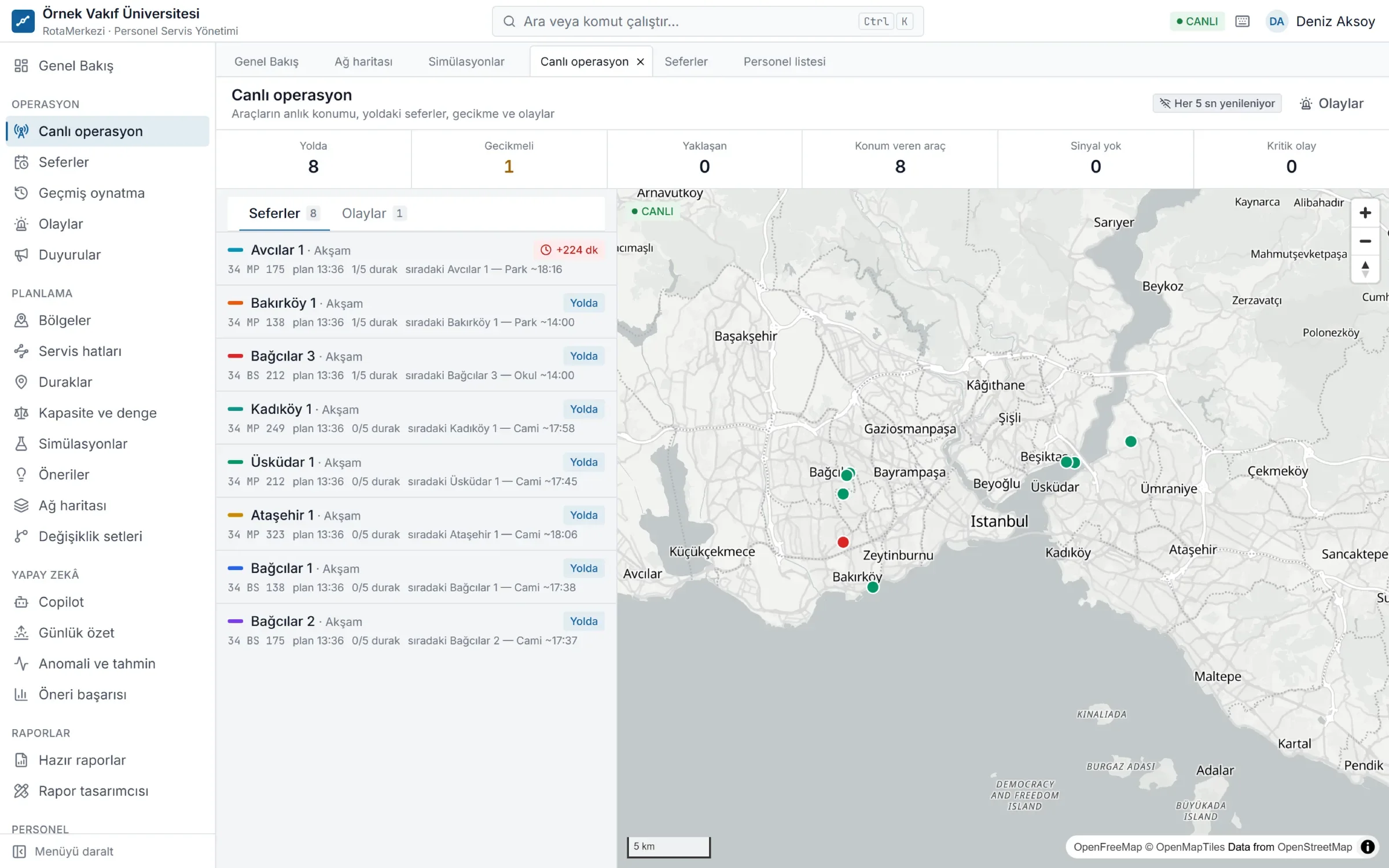
Where is the shuttle, and when will it arrive?
Vehicle locations come from a GPS device, an MQTT bridge or the driver app and are shown live on the map. The estimated arrival time for each stop is continuously updated.
Proactive alerts
- Delay: An alert when the deviation from the scheduled time exceeds the threshold
- Route deviation: When the vehicle leaves the planned route
- GPS loss: When no location has arrived for a set period
- Operational events such as over-capacity and vehicle changes
The rules engine turns alerts into incident records and sends them to the responsible people by email / notification. In the passenger portal, passengers see the live location of their own shuttle.
Live Operations Center
The operations team's everyday working screen:
- Map: Vehicles move smoothly and are color-coded by delay status (on time, delayed, very delayed; gray when there is no signal).
- Summary: Counts of vehicles on the road, delayed, approaching and without signal, plus critical incidents.
- Trip list: The most delayed at the top.
- Trip details: Planned route, the path the vehicle actually took, planned / actual times and estimated arrival per stop, the number of passengers on board and related incidents.
Updates arrive instantly over a real-time connection; if the connection drops, the screen refreshes itself every few seconds.
How are arrival and delay calculated?
- Arrival at a stop is detected when the vehicle enters the stop's arrival radius (with a tolerance for location accuracy).
- Delay is calculated against the last stop reached; for subsequent stops, estimated arrival = scheduled time + delay.
- A morning trip is completed when the vehicle enters the campus area (geofence); an evening trip, at the last stop.
- If the vehicle leaves the planned route corridor for longer than a set time, a deviation record and an incident are opened; the deviation closes when the vehicle returns to the route.
Incident and crisis management
GPS loss, route deviation, delay, breakdown, accident, traffic and passenger-related incidents are recorded with a priority level. Incidents follow a "new → assigned → resolved" flow; a resolution note is mandatory and a timeline is kept. Automatic incidents are deduplicated, and their priority rises as a delay grows. Critical incidents are shown in a banner at the top of the live screen together with the number of affected passengers.
Location sources
- Vehicle tracking device: Over HTTP or in the notification formats of common vehicle tracking providers (e.g. Teltonika, Arvento, Mobiliz), with a device-specific access key.
- MQTT: A direct location stream from devices.
- Driver app: If the vehicle has no device, the phone's location is used, and only while the trip is under way.
Privacy
Location is recorded only for the duration of a trip; locations outside trips are not stored. What is tracked is the shuttle vehicle, not the employees. Location history is automatically deleted after the period set by the organization.
Frequently asked questions
Do vehicles need a GPS device for live tracking?
No. If the vehicle has a tracking device, its location is used; if not, the driver app sends the phone's location during the trip. Live tracking and arrival estimates work either way.
Can employees see where their shuttle is?
Yes. In the passenger portal, once the trip is under way, employees see their own shuttle's location and estimated arrival time. This feature can be turned on or off in the organization settings.
How long is location data kept?
For the period set by the organization (90 days by default). Monthly location data past that period is deleted automatically. Locations outside trips are never recorded.
What happens if the GPS signal is lost?
If no location arrives from a trip on the road for a set period, a "GPS loss" incident is opened and the operations team is alerted. When the signal returns, the incident closes automatically.