Transparent payments to shuttle subcontractors with vendor payment and SLA tracking
Ways to make vendor payment calculations transparent for organizations working with a subcontracted shuttle company. Pricing models, SLA definitions, evidence from tracking data, approval flow and dispute management.
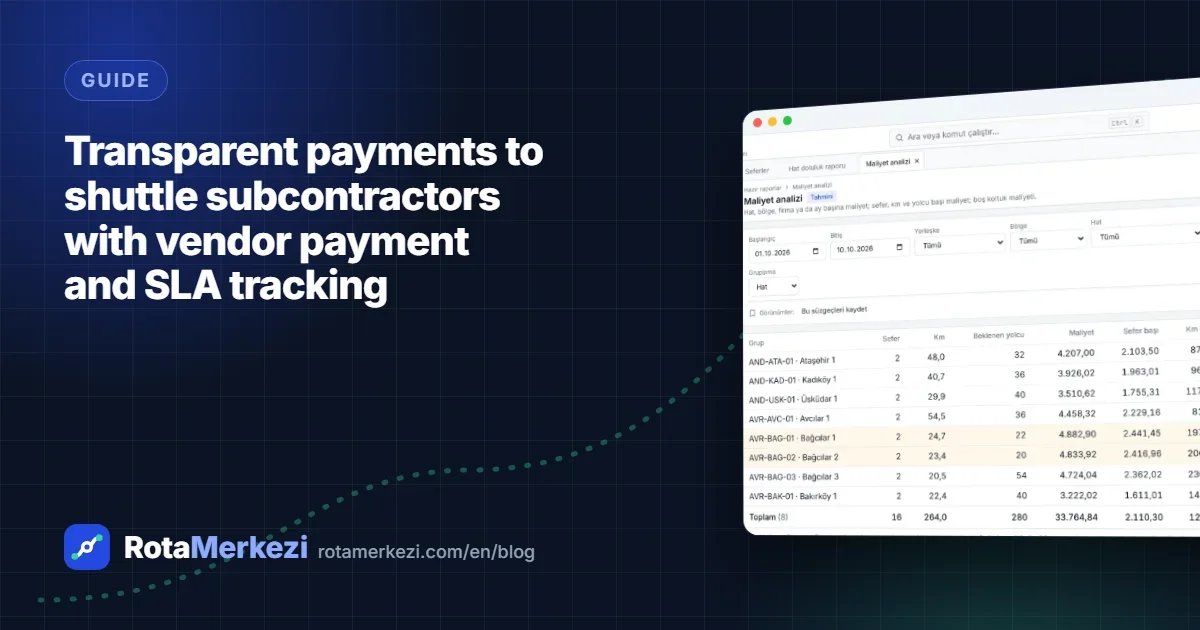
A shuttle vendor payment (progress payment) is the amount an organization periodically pays its subcontracted shuttle company, and to be transparent it must rest on three things: a clear pricing model, measurable SLA indicators and actual performance data that proves those indicators. When the vendor payment calculation relies on trip lists confirmed over the phone and hand-filled spreadsheets instead of these three elements, it turns into a contentious process for both the organization and the vendor. In this guide, we explain how to set up the process from start to finish.
Why do vendor payments become contentious?
Most disputes with a subcontracted shuttle company arise not from bad faith but from the lack of a shared data source:
- The organization's trip list and the vendor's invoice come from different sources.
- The answer to "was the trip run?" depends on the driver's word.
- Delay and cancellation records are scattered; people try to remember them at the end of the month.
- When the organization wants to apply the penalty clauses in the contract, there is no evidence.
- The person who does the calculation is often the same person who approves it.
The solution is to turn the vendor payment from a subject of negotiation into a result produced from measured data.
Contract pricing models
Three pricing models are commonly used in employee shuttle contracts. Each has different measurement needs:
| Model | How is it calculated? | What you need to measure | Watch out for |
|---|---|---|---|
| Per trip | Number of completed trips × unit price | Completed trips | The definition of a "completed trip" must be clear |
| Per kilometer | Actual km × price per km | Route distance or GPS trace | Planned or actual km? |
| Fixed monthly per vehicle | Number of vehicles × monthly fee | The vehicle being in service throughout the month | Unused days, spare vehicles |
Organizations sometimes combine these models; for example, a fixed monthly fee plus a per-trip fee for additional trips. Whichever model is chosen, the measurement method must also be written into the contract.
SLA definitions: what will you measure, and how?
An SLA (service level agreement) makes the service quality expected from the vendor measurable. A good shuttle SLA usually includes the following indicators:
Punctuality
The vehicle reaching the stop or campus within a certain tolerance of the planned time. Points to clarify in the definition:
- Tolerance (up to how many minutes of delay are acceptable?)
- Measurement point (first stop, last stop or destination?)
- How exceptions such as traffic accidents and weather conditions are handled
Trip completion and cancellation
How many of the planned trips were actually run. Vendor-caused cancellations and organization-caused cancellations (e.g. public holidays, shift changes) should be classified separately.
Vehicle standards
Requirements such as vehicle age, seating capacity, air conditioning and document validity (inspection, insurance, registration). Driver documents (driving license, SRC professional driver certificate, psychotechnical assessment, as required in Turkey) can also be tracked under this heading.
The problem of unmeasurable indicators
The contract should also state what happens if there is no data for an indicator (for example, if no location came from the vehicle). A fair approach: no data, no penalty, but the lack of data itself is reported separately and, if it recurs, treated as a separate clause.
Evidence from tracking data
What makes a vendor payment transparent is that there is a record behind every line. The sources of evidence are:
- Live vehicle tracking: locations from the GPS device or the driver app show when the vehicle reached the stop.
- Trip records: the times when the trip started, the stops were visited and the trip was completed.
- Boarding records: boardings recorded by QR, card or manual check-off confirm that the vehicle actually carried passengers.
- Incident records: exceptions such as breakdowns, accidents and vehicle changes, with resolution notes.
When this data is kept in a single system that both the organization and the vendor can see, the end-of-month "our records are different" argument largely disappears.
A hypothetical vendor payment example
The table below uses entirely hypothetical figures to show the vendor payment logic for a single line priced per trip.
Example: unit price of 1,000 TL per trip (TL is the Turkish lira); under the contract, a penalty of 10% per trip for delays over 10 minutes, and a penalty equal to the trip fee for vendor-caused cancellations.
| Item | Count | Calculation | Amount (TL) |
|---|---|---|---|
| Planned trips | 44 | — | — |
| Completed trips | 42 | 42 × 1,000 | 42,000 |
| Vendor-caused cancellations | 2 | 2 × 1,000 penalty | −2,000 |
| Delays outside tolerance | 3 | 3 × 100 | −300 |
| Trip without location data | 1 | No data, no penalty | 0 |
| Vendor payment | 39,700 |
The figures are only meant to illustrate the calculation logic; they do not reflect an actual contract or market price.
Approval flow: the four-eyes principle
When the person who calculates the vendor payment is also the person who approves it, the risk of both error and abuse increases. A healthy flow looks like this:
- After the month is closed, the vendor payment is calculated from completed trips.
- The person who calculated it checks it and adds explanations if needed.
- A different authorized person reviews and approves the vendor payment.
- The approved vendor payment is frozen; it cannot be changed afterwards.
- It is sent to the vendor together with a trip-by-trip breakdown.
Dispute management
The vendor should have the right to dispute, and disputes should be recorded. For a good dispute process:
- The dispute period should be defined in the contract.
- Disputes should be made per trip ("this trip on this date should not count as delayed, because...").
- Evidence (location trace, incident record) should be visible to both parties.
- The outcome and the reasoning should be recorded in writing.
When the vendor's representative can see their own trips in the system, most disputes are resolved before the month even closes.
Vendor payments and SLAs with RotaMerkezi
RotaMerkezi's cost management and vendor payments module supports the process above within the product:
- Line and trip costs are calculated according to per-trip, per-kilometer and fixed monthly contract types.
- Vendor payments are calculated from completed trips for closed months.
- SLA indicators such as punctuality and trip completion are measured, and the contractual penalty is applied to trips that breach them; for an indicator that cannot be measured, no penalty is applied and it is marked as "no data."
- The vendor payment is finalized and frozen with the approval of an authorized person other than the one who calculated it.
- With fleet, driver and vendor management, contracts and vehicle and driver documents are kept in one place; the vendor's representative can see their own trips.
- Evidence comes from live vehicle tracking and trip records; vendor performance and SLA reports are ready on the reporting screen.
To see how it works with your own contract structure, you can request a demo.
Frequently asked questions
Should vendor payments be calculated from planned trips or completed trips?
From completed trips, for transparency. Planned trips are the baseline for comparison; the difference should be explained as cancellations, additional trips or missing data.
Can the SLA be measured if the vehicle has no GPS device?
Yes, the driver app can be used as the location source. What matters is that location data arrives regularly and that the contract defines how cases without data are handled.
Don't penalty clauses damage the relationship with the vendor?
When the rules are clear from the start, measurement is shared and evidence is visible to both parties, a penalty becomes a predictable outcome rather than an argument. This often strengthens the relationship.