How to reduce employee shuttle costs: calculation and vendor payments
Reducing employee shuttle costs starts with measuring them correctly. Using a worked example, we explain levers such as occupancy, line length, vehicle type and shift alignment, how to calculate cost per person and how to make vendor payments transparent.
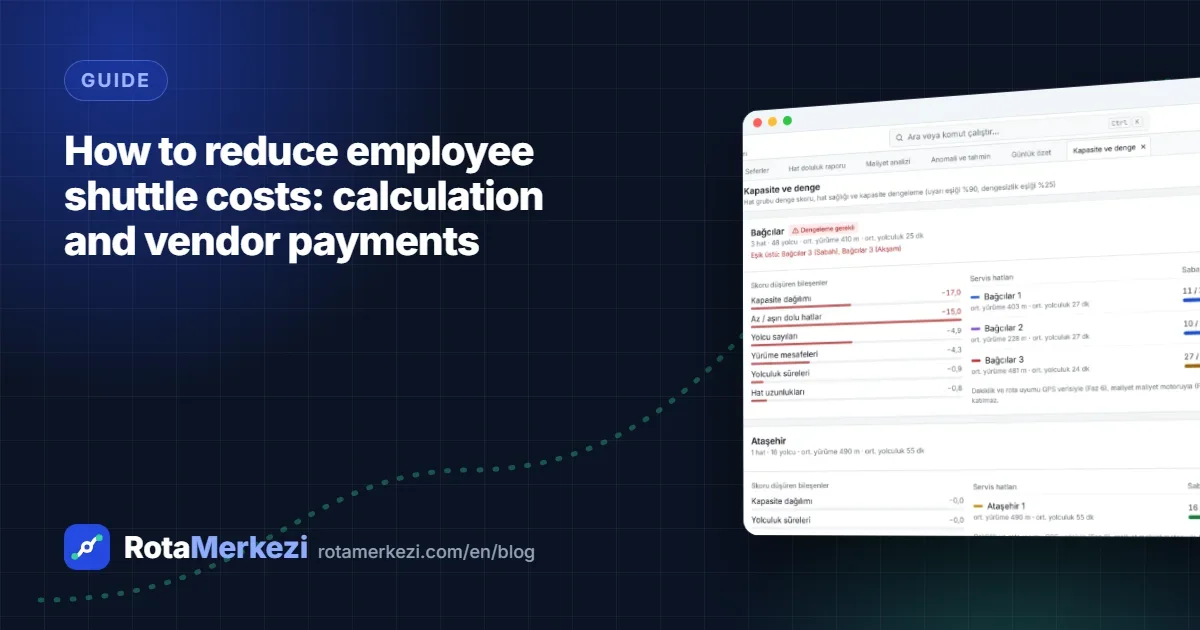
The most effective way to reduce employee shuttle costs is to first measure cost accurately per line and per person, then manage levers such as occupancy, line length, vehicle type and shift alignment with data. Blind cuts damage service quality, while measurement-based adjustments can make it possible to carry the same employees with fewer vehicles and kilometers. In this guide, we explain the levers, how to calculate cost per person and how to make vendor payments (progress payments) transparent.
Measure first: where does the cost come from?
In most organizations, shuttle cost appears as a single item: the monthly vendor invoice. Yet without knowing which line, which shift and which campus that amount comes from, every attempt to save money is based on guesswork.
The key indicators you need to measure:
- Monthly cost per line: the amount calculated according to the contract type (per trip, per kilometer, fixed monthly).
- Monthly cost per person: line cost divided by the number of employees who actually use that line.
- Cost per ride: line cost divided by the total number of boardings in the month.
- Cost per kilometer: line cost divided by the total kilometers driven in the month.
- Occupancy rate: the ratio of the average number of passengers boarding to vehicle capacity.
It is important to look at actual, not planned, data. In a hypothetical example, 25 people may be assigned to a line; but if boarding records show that an average of 15 people board each day, your cost-per-person calculation changes accordingly.
How to calculate cost per person (worked example)
The figures below are entirely hypothetical, round numbers chosen only to illustrate the method; they do not reflect actual market prices. (TL is the Turkish lira.)
Worked example — Line A (hypothetical):
- Vehicle: 27-seat midibus
- Contract: fixed monthly fee of 100,000 TL
- 20 working days per month, 2 trips per day (inbound and outbound)
- Line length: 25 km one way
- Average of 18 passengers per trip according to boarding records
| Indicator | Calculation | Result (example) |
|---|---|---|
| Occupancy rate | 18 / 27 | about 67% |
| Monthly cost per person | 100,000 / 18 | about 5,560 TL |
| Total monthly boardings | 18 × 2 × 20 | 720 boardings |
| Cost per ride | 100,000 / 720 | about 139 TL |
| Monthly kilometers | 25 × 2 × 20 | 1,000 km |
| Cost per kilometer | 100,000 / 1,000 | 100 TL |
When you do the same calculation for every line, the lines whose cost per person is clearly above average stand out immediately. These are usually lines with low occupancy, long routes or the wrong vehicle type.
Levers that reduce cost
1. Increase occupancy and see the empty seats
An empty seat is capacity you pay for but don't use. Ways to increase occupancy:
- Measure actual occupancy with boarding data (QR, card or driver check-off)
- Make it easy for employees to send an "I won't be riding today" notice
- Direct new employees to lines that have spare capacity
2. Review line length and stop sequence
Stops added over the years make lines longer. Reordering the stop sequence or merging stops used by very few people with a neighboring stop can reduce kilometers and ride time. The maximum walking distance for employees must be respected here.
3. Merge or split lines
If two half-empty lines can be served by a single vehicle, merging them makes sense. Conversely, splitting an overly long and crowded line in two can shorten ride time and improve service quality.
Example (hypothetical): Line B and Line C pass through the same area, each carrying 12 passengers a day in 27-seat vehicles and each costing 100,000 TL a month. Cost per person on each is 100,000 / 12 ≈ 8,330 TL. If the two lines are merged into one vehicle and the fee rises to 115,000 TL because the route is longer, cost per person for 24 passengers becomes 115,000 / 24 ≈ 4,790 TL. The effect of this decision on ride time must always be assessed as well.
4. Choose the vehicle type to match demand
Running a large vehicle on a line that consistently carries 10–12 people is an unnecessary cost; running a small vehicle on a line that consistently has standing passengers creates both comfort and safety problems. Choose the vehicle type based on actual occupancy data.
5. Align shift times with the shuttle
Running separate shuttles for shifts that start at close times increases the number of vehicles. Aligning shift start times with small adjustments can allow the same vehicle to serve more than one shift. This decision should be made together with HR and department managers.
6. Try changes in a scenario first
Seeing the impact of merging lines, changing vehicle types or introducing a new shift before applying it to live operations reduces risk. In RotaMerkezi, scenarios are compared by their impact on daily kilometers, vehicle count, average ride time and monthly cost; route optimization redesigns the selected lines under capacity and maximum ride time constraints.
Transparent vendor payments and SLAs
A significant part of the cost is determined in the vendor contract. Making the vendor payment process transparent reduces both unnecessary payments and disputes with the vendor.
- Vendor payments based on completed trips: completed trips, not planned ones, should be the basis.
- Measurable SLA indicators: indicators such as punctuality and trip completion are measured from live tracking data.
- Contract-based penalties: the penalty defined in the contract is applied to trips that breach it.
- No data, no penalty: not applying a penalty when an indicator could not be measured is a fair approach toward the vendor.
- Four-eyes approval: finalizing the vendor payment only with the approval of an authorized person other than the one who calculated it is important for internal control.
RotaMerkezi's costs and vendor payments module follows this approach: vendor payments are calculated from completed trips for closed months and frozen once approved.
Checklist
| Question | Why does it matter? |
|---|---|
| Do we know the cost per line? | It shows where savings will come from |
| Do we measure actual occupancy? | Planned occupancy is often misleading |
| Have lines with high cost per person been identified? | It enables prioritization |
| Do vehicle types match occupancy? | It reduces the cost of unnecessary capacity |
| Are shift times aligned with the shuttle? | It affects the number of vehicles |
| Are vendor payments based on completed trips? | It ensures payment transparency |
Conclusion
Reducing employee shuttle costs is not about cutting service but about directing resources to the right place. Accurate measurement, scenario comparison and transparent vendor payments are its three cornerstones. To look together at what cost per person would look like in your own shuttle network, you can request a demo or take a look at the reporting feature.
Frequently asked questions
What data should be used to calculate shuttle cost?
The contract fee, the number of completed trips and kilometers, and the actual number of passengers obtained from boarding records. Planned assignments alone can be misleading.
Is there an ideal value for shuttle cost per person?
There is no universal ideal value; it varies by city, distance, vehicle type and contract. What really matters is comparing your lines with one another and over time.
How are SLA penalties applied to shuttle vendor payments?
Indicators defined in the contract, such as punctuality and trip completion, are measured, and the contractual penalty is applied to trips that breach them. Not applying a penalty for an indicator that could not be measured is a fair approach.