What is route optimization? Route planning for employee shuttles
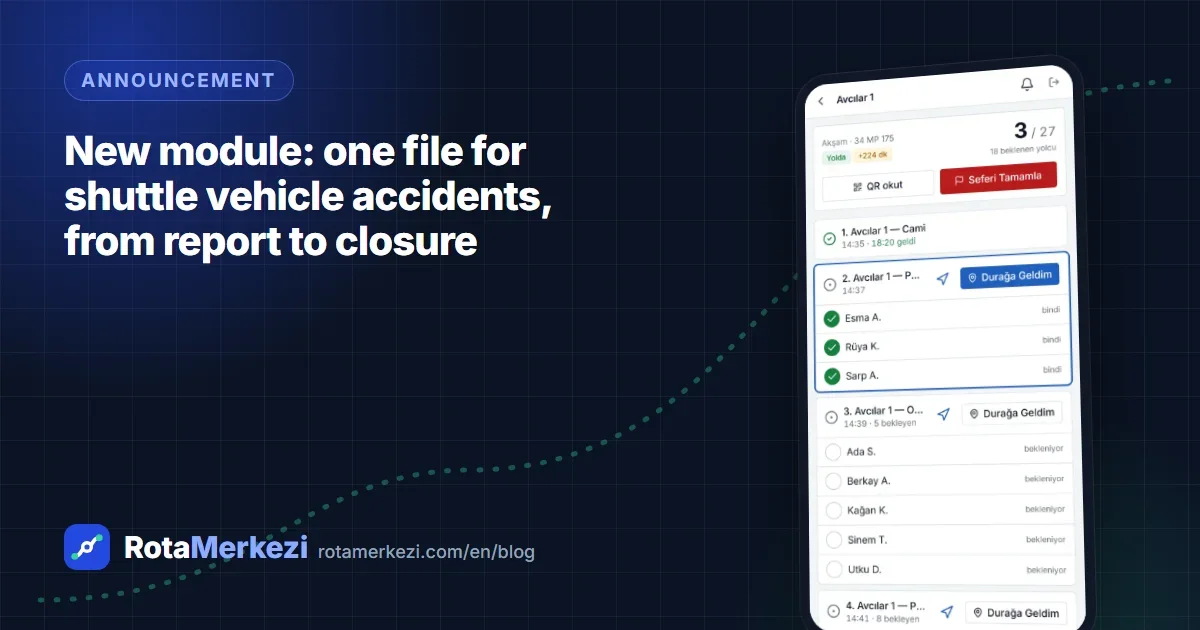
Route optimization means finding routes that carry the same employees with fewer vehicles and kilometers. We explain TSP and VRP in plain language, the constraints specific to employee shuttles and the steps to apply the result with confidence.
Route optimization is the task of finding routes that carry passengers at given stops using the fewest vehicles, kilometers or minutes while respecting constraints such as vehicle capacity and time limits. For employee shuttles, this means line designs that carry the same employees on shorter rides at lower cost. A good result, however, needs accurate data, realistic constraints and human approval as much as it needs mathematics.
Why route optimization?
Employee shuttle lines usually take shape over years, as needs arise. A new department opens, a stop is added, an existing line is extended a little for an employee who moved to a new neighborhood. In the end, some lines become longer than necessary, some half-empty and some overcrowded.
Manual planning works for a few lines. But with dozens of lines, hundreds of stops and more than one shift, the number of possible combinations quickly exceeds what a person can explore by trial and error. This is where route optimization comes in.
TSP and VRP in plain language
The traveling salesman problem (TSP)
A salesman must visit several cities once each and return to where he started. In which order should he travel so that the total distance is shortest? This is known as the traveling salesman problem (TSP).
Determining the stop sequence on a single shuttle line is similar to the TSP: the vehicle will call at every stop and arrive at the campus; which order gives the shortest route?
The vehicle routing problem (VRP)
In real life there is never just one vehicle. There are several vehicles, each with limited capacity, and the time passengers can spend on the shuttle is also limited. Which stop should be given to which vehicle, and in what order should each vehicle visit its stops? This is called the vehicle routing problem (VRP).
| Concept | The question it asks | Equivalent in employee shuttles |
|---|---|---|
| TSP | What is the best visiting order for one vehicle? | The stop sequence on a line |
| VRP | How should stops be divided among and ordered for several vehicles? | Redesigning lines |
| Capacitated VRP | How do you distribute stops without exceeding vehicle capacity? | Lines that match the number of seats |
| VRP with time windows | How do you respect specific time windows? | Arriving on time for the start of the shift |
As these problems grow, finding the exact optimal solution becomes very difficult. That is why, in practice, solvers and heuristic methods that produce very good solutions in a short time are used.
Constraints specific to employee shuttles
The quality of optimization depends on how well the defined constraints reflect reality. The main constraints for employee shuttles are:
- Vehicle capacity: the number of passengers each vehicle can carry.
- Maximum ride time: the longest time an employee may spend on the shuttle. Without this limit, optimization may condemn some passengers to very long rides in order to reduce kilometers.
- Shift times and time windows: the shuttle must reach the campus before the shift starts.
- Maximum walking distance: a reasonable distance for an employee to walk from home to the stop.
- Number of routes: the maximum number of vehicles or lines that can be used.
- Road network reality: distances and durations should be calculated on the actual road network, not as the crow flies.
Steps in route planning
1. Prepare the data
Converting employee addresses into accurate locations, keeping stops up to date and having complete shift information are the foundation of optimization. Optimization with bad data produces bad results.
2. Define the stops
New stop locations can be suggested for clusters of employees outside coverage, that is, those not within a reasonable walking distance of any stop. In RotaMerkezi, passenger assignment and stop suggestions support this step.
3. Make the assignments
Each employee is placed on a stop and a line by considering walking distance, line occupancy, shift fit and ride time together.
4. Calculate the routes
The stops with passengers on the selected lines are solved as a VRP with the defined constraints. This yields the stop sequence, distance and duration.
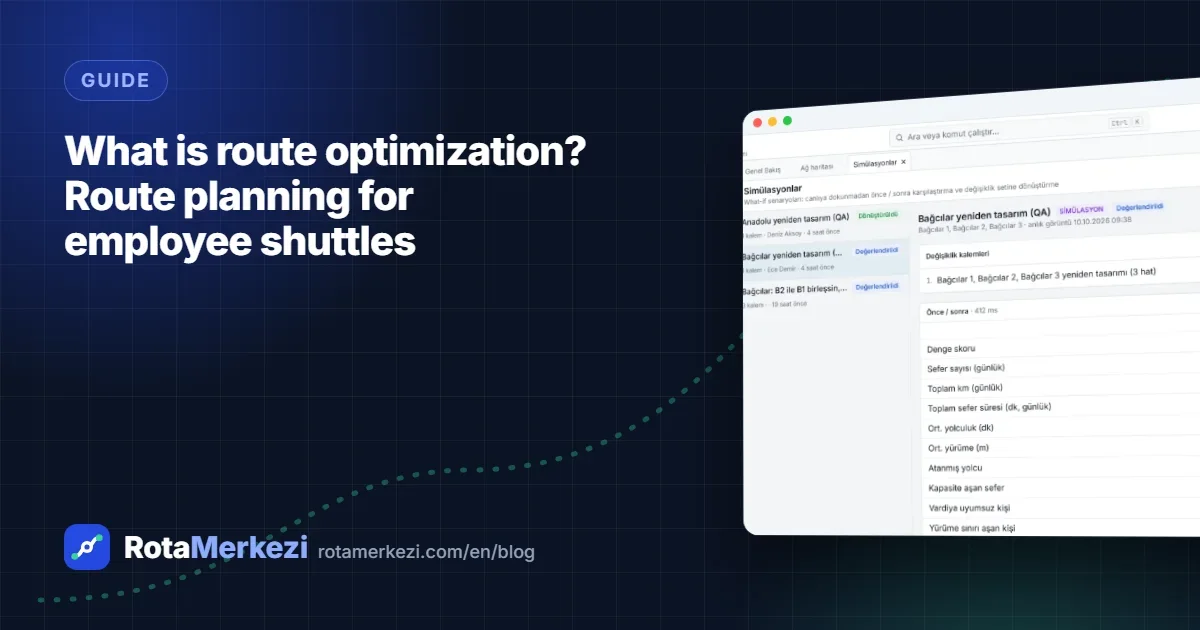
5. Compare before and after
Comparing the proposed plan with the current situation is essential. The main indicators to compare are:
- Total daily kilometers
- Number of vehicles required
- Average and maximum ride time
- Monthly cost difference
- Number of employees whose stop or line changes
6. Approve and apply
Optimization produces a proposal; a human makes the decision. Having the change reviewed and approved by an authorized person other than the one who prepared it (the four-eyes principle) prevents flawed or hastily applied plans. Having the change take effect on a specific date also allows time to inform employees in advance.
How does route optimization work in RotaMerkezi?
In RotaMerkezi, the process is integrated with the planning tools:
- Route designer: stops are ordered by dragging them on the map; distance and driving time are recalculated with every change. Morning and evening directions are managed separately; if a routing provider is configured, the route is drawn on the actual road network. Details are on the route designer page.
- Line redesign (VRP): lines selected within a scenario are redesigned under vehicle capacity, maximum ride time and maximum number of routes constraints. Morning routes are calculated; evening routes follow the same stops in reverse order, and employees' stops do not change.
- Two solvers: the solution is calculated in parallel with Google OR-Tools and a built-in heuristic solver; the better one is chosen.
- Matching: proposed routes are matched with existing lines by passenger overlap; any extra route is proposed as a new line.
- Scenarios and approval: the result is shown as the difference in daily kilometers, vehicle count and monthly cost. A scenario found suitable is turned into a change set and applied with the approval of an authorized person other than the one who prepared it. The approved plan and the applied plan are exactly the same.
You can find the details of this approach on the route optimization and scenarios and approval pages.
Common mistakes
- Looking only at kilometers: if no ride time limit is set, employee satisfaction drops.
- Working with outdated data: employees who have left or changed addresses distort the result.
- Ignoring actual occupancy: the number of passengers who actually board, not those assigned, should be the basis.
- Changing the whole network at once: starting with a few lines makes it easier to measure the impact.
- Neglecting communication: employees whose stop or time changes should be informed in advance.
Conclusion
Route optimization is one of the most powerful tools for designing a shuttle network with data instead of guesswork; but it delivers reliable results only when used with realistic constraints, a before-and-after comparison and human approval. To see what kind of scenario your own lines would produce, you can request a demo or explore the route optimization feature.
Frequently asked questions
Are route optimization and route planning the same thing?
Route planning is the entire process of designing routes; it can also be done by hand. Route optimization is the part of that process where mathematical methods are used to calculate the most efficient routes that satisfy the constraints.
Does a VRP solution always give the best result?
For large problems, finding the exact optimal solution is very hard in practice; solvers produce very good solutions in a short time. The quality of the result also depends on the accuracy of the data and constraints entered.
Is the optimization result applied directly?
It should not be. In RotaMerkezi, the result is first compared as a scenario, then turned into a change set and applied with the approval of an authorized person other than the one who prepared it.